What is cognitive processing speed?
Cognitive processing speed is how quickly your brain takes in a simple piece of information, interprets it, and responds. It has nothing to do with how "smart" someone is in the sense of reasoning well — it's about how long it takes to execute a basic mental operation: reading a symbol and matching it to another, spotting whether two shapes are identical, hitting a key the instant a stimulus appears.
On IQ (intelligence quotient) tests, this ability is usually measured with tasks that are deliberately simple and timed: symbol search, number-coding tasks, quick visual comparisons. What gets scored isn't whether you get it right — almost everyone does — but how many you solve correctly within a time limit, typically 90 or 120 seconds.
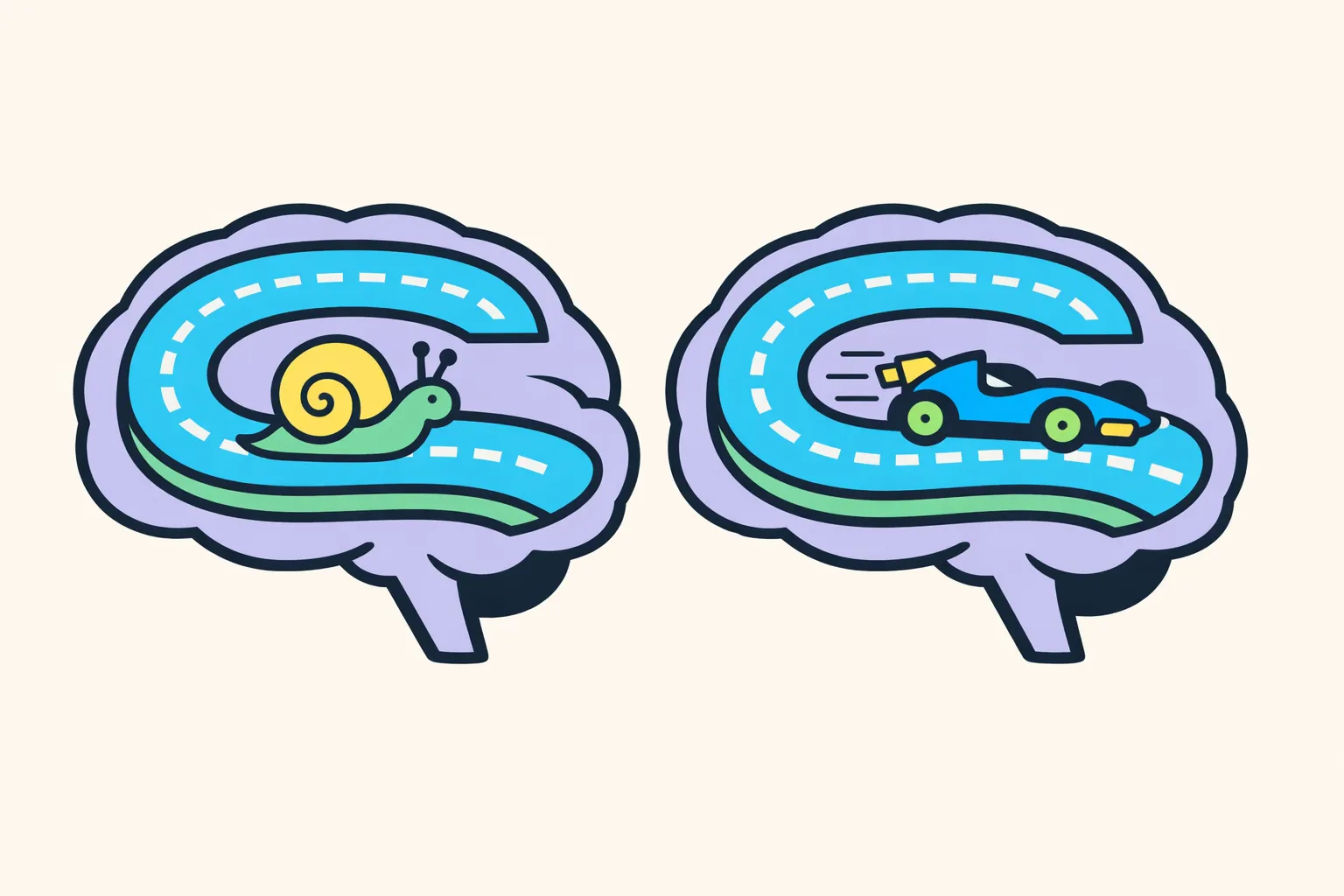
This sets it apart from abstract reasoning or verbal reasoning, which assess the quality of your thinking, not its speed. You can be exceptionally good at solving complex matrices while also being fairly slow at marking matching symbols against the clock. These are separate skills that coexist in the same person — which is exactly why two people with the same IQ (a score that compares your reasoning ability to the general population) can have completely different speed profiles.
Why two people with the same IQ can perform very differently
Overall IQ is an average of several abilities: verbal reasoning, perceptual reasoning, working memory, and processing speed, among others depending on the test. Two people can land on the same final number by completely opposite routes.
Picture Martha and Jon, both with an IQ of 118. Martha has extremely high abstract reasoning but mediocre processing speed; Jon has processing speed well above average but somewhat weaker reasoning. The average puts them at the same final score, but in real life this shows up:
- Martha needs more time on a timed exam, even though she understands the material better than most people.
- Jon responds quickly in interviews and urgent tasks, but can fall short on problems that require deep reflection without time pressure.
This split is exactly what a detailed report reveals that a single number can't: it's not enough to look at total IQ — you need to look at the index scores behind it. That's why psychologists and counselors insist on not reducing intelligence to one figure, something we also cover when discussing what cognitive ability is in broader terms.
How it's actually measured: tasks, timing, and scoring
Processing-speed tests share one design principle: the content is trivial, the pressure is time. This is intentional — if the task were hard to understand, you'd be measuring reasoning, not speed.
| Task type | What it asks | Typical time | What it really measures |
|---|---|---|---|
| Symbol search | Decide whether a target symbol appears in a group | 90-120 s | Visual scanning and quick decisions |
| Number coding | Copy a symbol matched to each number using a key | 90-120 s | Visual-motor coordination and sustained attention |
| Simple reaction time | Press as soon as a stimulus appears | Milliseconds per trial | Pure nervous-system speed |
| Choice reaction time | Press a different key depending on the stimulus | Milliseconds per trial | Speed + basic decision-making |
The score comes from the number of correct answers within the time limit, not raw speed alone — mistakes made from rushing count against you too. This stops someone from "cheating" by guessing at random.
If you want to experience this logic firsthand, iqmetria's reaction test is built exactly for that: simple stimuli, an active timer, and zero room for prior knowledge to game the result.
Mental speed vs. general intelligence: the difference almost no one explains
It's tempting to think "if they're faster, they're smarter." The evidence doesn't back up that shortcut. Processing speed correlates with the g factor (the general underlying ability shared by all cognitive tasks), but the correlation is moderate, not perfect.
Put another way: mental speed supports reasoning, but it doesn't replace it. An expert chess player doesn't move pieces faster than a beginner because of superior reflexes — they do it because they recognize patterns a beginner takes time to spot. That's a case where reasoning beats raw speed.
Where speed really matters:
- Strictly timed exams (civil-service exams, psychometric screening tests).
- Jobs with a constant flow of information demanding fast decisions (air traffic control, trading, emergency medicine).
- Reflex-based video games and reaction sports.
Where it barely matters at all:
- Solving a complex problem with no clock running.
- Writing an essay, designing a long-term strategy, or coding without an immediate deadline.
This distinction explains why someone brilliant in their day-to-day work can feel "slow" on a timed test, and vice versa.
What factors make processing speed fluctuate
Reaction speed isn't a fixed constant carved in stone. It shifts for reasons worth knowing before you draw conclusions about yourself.
| Factor | Typical effect on speed |
|---|---|
| Age | Increases through childhood and adolescence, peaks around ages 20-30, then gradually declines |
| Fatigue and sleep | Sleep deprivation can slow reaction time noticeably — in some studies, even more than alcohol |
| Practice with the format | Repeating the same task type improves the score without changing the underlying ability |
| Mood and anxiety | Acute stress can speed up simple reactions but worsens accuracy on decision-based tasks |
| Caffeine or stimulant intake | Can temporarily improve reaction time on simple tasks |
| Medical or neurological conditions | Certain conditions can affect it, but this calls for a professional evaluation, not an online test |
This ties into a related topic: just as IQ changes with age in relative terms, processing speed follows its own life curve — a different one from crystallized reasoning, which can actually keep improving over the years.
Common mistakes when interpreting processing speed
There are a few conclusions people draw from a speed result that simply don't hold up:
- "If I took longer, I'm less intelligent." Not true as a general rule. Speed is one index, not the whole picture. Someone can have excellent reasoning and only modest speed.
- "Being fast always signals strong cognition." Not that either. Answering quickly with frequent mistakes usually points to impulsiveness, not ability.
- "A poor result on an online reaction test means a neurological problem." A few-minute orientative test diagnoses nothing; it might simply reflect that you were tired, using an unfamiliar mouse, or on a laggy device.
- "You can train processing speed like a muscle and significantly raise your overall IQ." Practice improves performance on that specific task format, but the room for improvement in pure speed is limited compared to the room for improvement in strategy and knowledge.
- "All reaction tests measure the same thing." Simple reaction time (one stimulus, one response) and choice reaction time (multiple stimuli, multiple possible responses) engage different processes; comparing results across different tests isn't valid.
Keeping these ideas separate helps you avoid drawing oversized conclusions from one isolated number.
What to do with this information in real life
Knowing your speed profile has practical value beyond simple curiosity.
If you know processing speed is your relatively weaker point:
- On timed exams, answer what you're confident about first and save the uncertain questions for last.
- Practice the specific test format beforehand — familiarity cuts down the time lost figuring out instructions.
- Avoid comparing your pace to someone else's in real time; anxiety over someone else's clock only hurts your own performance.
If speed is your strong suit:
- Watch your accuracy on tasks that reward reflection rather than just quickness — going fast isn't always an advantage.
- In jobs involving decisions under pressure, this can be a genuine asset, but it's worth pairing with deliberate pauses for high-stakes decisions.
Either way, this data point alone doesn't define your overall ability. It's one piece of the puzzle, useful alongside others — like numerical reasoning or working memory — for understanding how you think, not for labeling you.
Key takeaways
- Cognitive processing speed measures how fast you handle simple, timed tasks, not the quality of your reasoning.
- Two people with the same IQ can have opposite speed profiles; the overall score hides that difference.
- It correlates with the g factor, but only moderately: being fast isn't the same as being generally intelligent.
- It varies with age, sleep, practice, and mood; it's not a fixed value.
- A single poor result on an online test doesn't indicate any clinical problem.
- Knowing your profile helps you choose a strategy for exams and work — not judge your overall capability.
If you want to see where your own reaction speed stands, iqmetria's free test gives you an orientative estimate in just a few minutes. It's a self-discovery tool, not a clinical evaluation or medical diagnosis — for that, you'll always need a professional.
FAQ
Is processing speed the same thing as intelligence?+
No. Processing speed measures how fast you handle simple, timed tasks, while intelligence (as measured by IQ) also includes reasoning, verbal ability, and working memory. The two correlate, but only moderately — a fast reaction time doesn't guarantee strong reasoning, and vice versa.
Can I improve my processing speed?+
You can improve your performance on a specific task format through practice, since familiarity reduces wasted time. However, the ceiling for improving pure processing speed is narrower than the ceiling for improving strategy, knowledge, or reasoning skills.
Why did I score low on a reaction test even though I consider myself sharp?+
A single low score on a short online test can reflect tiredness, an unfamiliar device, or momentary stress rather than your actual cognitive ability. These orientative tests are a self-discovery tool, not a clinical or medical diagnosis.
Does processing speed decline with age?+
Yes, on average. It tends to rise through childhood and adolescence, peak around ages 20-30, and gradually decline afterward — unlike crystallized knowledge and reasoning, which can keep improving well into later life.